Choosing Writing Over Everything Else
2026: Building an author’s life, not a creator business

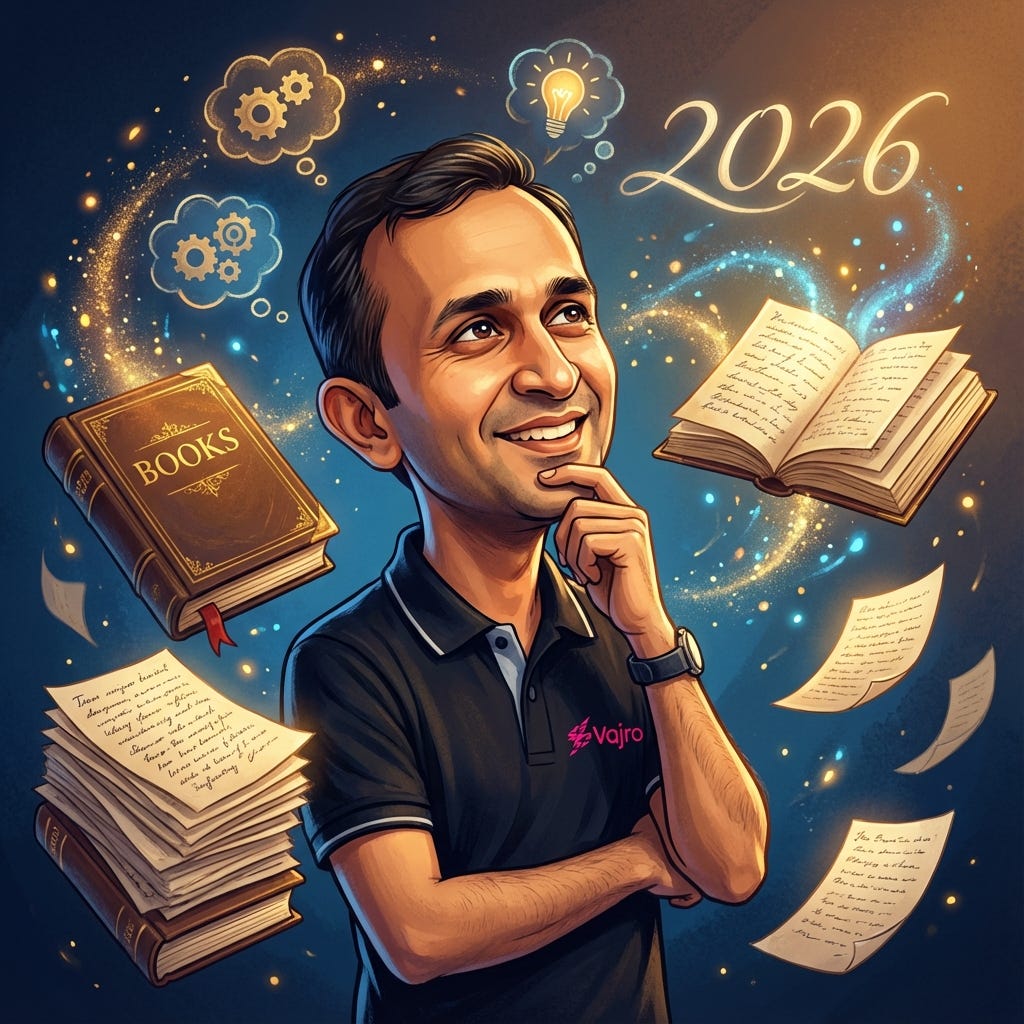
Over the last few months, I’ve been noticing a quiet mismatch between what I was setting up — and what I actually wanted to do with my time.
I didn’t come to writing to build funnels, tiers, or products. I came to writing because it’s the most exciting way I know to think. Ideas sharpen when I’m forced to put them into words. Arguments reveal their weaknesses. Half-formed thoughts either collapse or become something worth keeping.
Somewhere along the way, it became clear to me that I don’t want to be a “creator” first. I want to be an author — someone whose primary output is ideas, shaped carefully over time, on the page.
Sharing those thoughts publicly isn’t a growth tactic for me. It’s the natural extension of the work itself. Writing, publishing, and thinking are not separate activities in my mind — they’re part of the same loop.
Once that clicked, a lot of other decisions started to feel obvious.
The path I’m choosing not to take
At various points, it would have been entirely reasonable for me to turn this into courses, cohorts, or structured programs. I know how that world works. I’ve seen what it takes to make them successful.
But I also know the trade-off that comes with it.
Selling courses isn’t just about the content. It demands constant visibility, repeated launches, audience warming, positioning, and promotion. Over time, at least half your energy goes into marketing the work instead of doing the work itself.
I’ve been through that grind before. It’s effective, but it quietly reshapes your priorities. Writing starts to serve the funnel. Ideas get filtered through conversion logic. You begin to ask whether something will sell before asking whether it’s worth saying.
I didn’t come back to writing to replay that cycle.
I came here because I wanted to spend most of my time thinking, writing, and refining ideas — not planning launches or optimizing attention.
Choosing not to build courses isn’t a rejection of that model. It’s a recognition that it’s not how I want to spend my creative energy right now.
Redefining freedom as a solopreneur
When people talk about freedom as a solopreneur, they usually mean financial freedom — predictable income, scalable products, and leverage that compounds.
That version of freedom matters. But it isn’t the one I’m optimizing for right now.
The freedom I care about most is the ability to sit down and write without asking whether a piece will make money. To explore an idea fully, even if it doesn’t fit a marketable shape. To follow a line of thought until it either becomes something meaningful — or proves itself unworthy.
Writing seriously requires that kind of space. The moment every piece has to justify itself commercially, the work changes. The edges soften. The risk drops. The thinking becomes safer.
I want the freedom to write with intent, not pressure. If the work eventually makes money, that’s a welcome outcome. If it doesn’t, I still have the satisfaction of having thought deeply and put something worthwhile into the world.
For me, that’s a form of freedom that’s hard to quantify — but very easy to lose.
What this place is (and what it isn’t)
Once I decided to approach this as an author first, I had to be honest about what this space should be.
This isn’t a product. It isn’t a funnel. And it isn’t something I’m trying to optimize for conversions.
This is where the work happens in public.
Substack, for me, is a place to publish thoughts as they take shape. Some pieces will be polished. Others will be exploratory. A few will change my mind as I write them. That’s part of the process.
I’m not using this space to sell courses or run launches. I’m using it to think, to write, and to build a body of work over time — openly and without artificial constraints.
If you’re reading this, you’re not here to be marketed to. You’re here because you’re interested in ideas as they’re being formed, not just when they’re finished.
That distinction matters to me, and it’s how I plan to use this space going forward.
Readers as insiders
If this space is where the work happens in public, then the people who subscribe aren’t an audience in the usual sense.
They’re early readers.
They see ideas before they’re fully resolved. They read drafts before they’re smoothed out. They watch arguments evolve, get refined, or sometimes get discarded entirely.
Over time, this will also mean advance reader copies of ebooks and longer projects — shared not as a transaction, but as a way of letting early readers see the work before it’s released into the world.
I like the idea of writing with a small group of thoughtful readers in mind. People who are curious, patient, and interested in how ideas are formed — not just in consuming finished outputs.
If you’re here, you’re not expected to do anything. No feedback obligations (great if you provide it though). No engagement rituals. Just read along, if and when something resonates.
That’s the kind of relationship I want this writing to have with its readers — quiet, respectful, and built over time.
Letting go of conversion pressure
One practical outcome of all this is simple: I’m not going to run a paid Substack.
That decision alone removes a surprising amount of invisible pressure. There’s no need to think in terms of upgrades, retention, or whether a piece is “worth” charging for. I don’t have to frame ideas around exclusivity or hold anything back to justify a price.
Without a paid tier, there’s no conversion math running in the background. No subtle shift in tone. No obligation to produce on a schedule dictated by revenue expectations.
What’s left is a much cleaner relationship with the work itself.
I can write when there’s something worth saying. I can publish pieces that are exploratory, incomplete, or narrowly interesting. I can let ideas breathe without worrying about whether they’ll perform.
Paradoxically, removing monetization makes it easier for me to take the writing more seriously. The work stands on its own, without needing to justify itself commercially.
That freedom — from metrics, from pressure, from constant self-optimization — is exactly what I was looking for when I took up writing.
Section 7 — Broad curiosity, clear direction
One natural consequence of removing monetization pressure is that I no longer need to niche myself into a narrow lane.
I don’t want to reduce my curiosity to a single topic just because it’s easier to package or market. The things I think about — AI, markets, health, work, leverage, and decision-making — aren’t separate silos in my mind. They’re different expressions of the same underlying interest: how people think, build, and choose.
That said, this isn’t going to be a stream of disconnected essays.
Over the next year, my writing will largely orbit around a few long-term bodies of work.
First, I’ll be writing a 10–12 ebook series on AI for non-coders — aimed at people who want to think clearly about AI, use it for leverage, and build systems around it, without needing to become technical.
Alongside that, I’ll be working on an ebook on markets — Market Cycles: Understanding the Layer Above Stocks — focused not on stock picking, but on timing, narratives, and the forces that move markets beneath the surface.
And finally, I’ll be developing an ebook around building an AI-first company — drawing from real operator experience, not demos or prompts, and focusing on how AI reshapes teams, systems, and decision-making.
These projects give my writing direction without constraining it. They allow me to explore ideas deeply, while still leaving room for essays on finance, health, or anything else that feels worth thinking through carefully.
The coherence won’t come from sticking to a niche. It will come from a consistent way of thinking — applied across different domains.
A quiet commitment
So this is the direction I’m choosing.
I’ll write seriously. I’ll publish thoughtfully. I’ll share ideas as they form, not just when they’re finished. Some pieces will resonate widely. Others may only matter to a handful of readers — and that’s fine.
I’m not trying to maximize reach or revenue here. I’m trying to build a body of work I can stand behind years from now.
If this work travels further — through books, readers, or conversations I never anticipated — that’s a natural consequence, not the objective. The objective is to write ideas that deserve to travel.
These are thoughts I believe are strong enough to stand on their own. What the world does with them is its decision.
For now, that’s enough.
And that’s what I’ll be doing here.